
The Namahage Ritual
An evening with the Namahage
The Namahage ritual varies from village to village. Just as each place has its own version of the story and the costumes, every community has its own way of carrying out the Namahage visit. In some areas, the Namahage are calmer and enter only the entrance hall, while in others they drag children and young people out the front door as they scream and cry. In some places, the visit is brief, while in others, the questioning lasts longer. In one area, the Namahage even make the children sing, and usually sing a song in return.
The ritual usually begins a few days before New Year’s Eve, when the members of the Namahage group gather to prepare the costumes. First, they make sure the masks are in good condition, repairing any damage and touching up faded paint. Then they take large sacks of rice straw and weave the cloaks from the strands. These cloaks, called kede or kera, are difficult to make, and there is usually a veteran Namahage who helps the younger members.
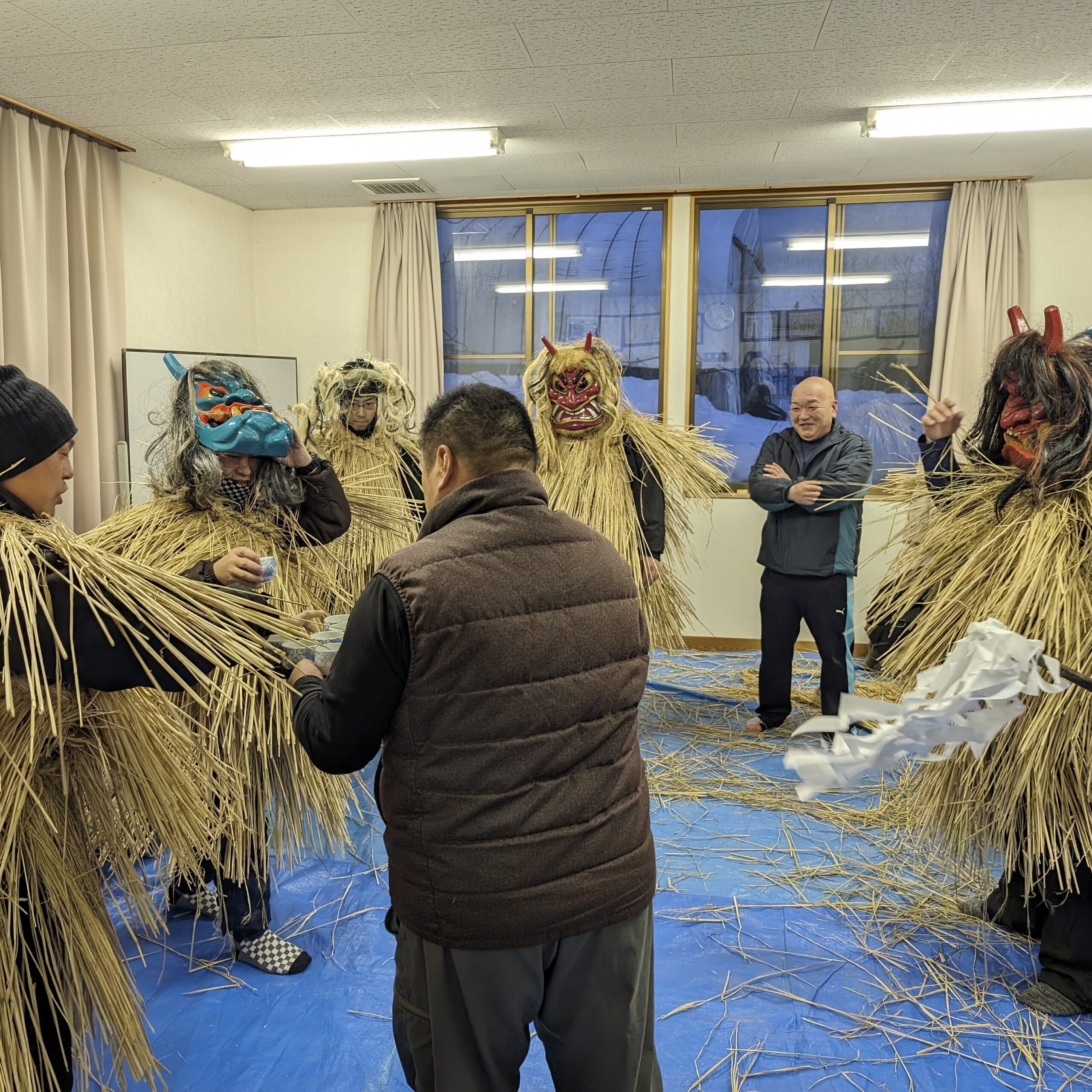
After the sun has set on New Year’s Eve, the members of the Namahage group gather at a local shrine or meeting hall. There, they put on their costumes made of rice straw or old rope and fishing nets. They then perform a Shinto purification ritual and put on the Namahage masks, “transforming” into Namahage. After that, they take their tools and head out into the village to visit as many households as they can.
Before the Namahage enter a home, a man called the sakidachi asks whether it is acceptable for them to come inside. The Namahage may not enter houses where there has been a death or a birth during the past year, as these are considered impure and must wait until the following year. The Namahage are regarded as deities and therefore will not enter homes with spiritual impurity.
Namahage usually move in groups of at least two, sometimes up to six, and they’re often accompanied by several sakidachi. One reason for this is that the men behind the masks often become quite drunk from all the sake they’re offered during the many visits. The sakidachi help keep the Namahage from getting lost and also serve as backup Namahage if needed.
When the Namahage know it is safe to enter the house, they storm in through the front door, stomping and shouting. They fling open the sliding doors with a loud crash, perform ritual stomps, and walk through the home bellowing phrases like: “Are there any lazy people?” “Any crying children?” “Any naughty children?” and so on. The Namahage’s voice is a deep, distinctive growl that can make the hair stand on end for any adult who grew up on the Oga Peninsula.
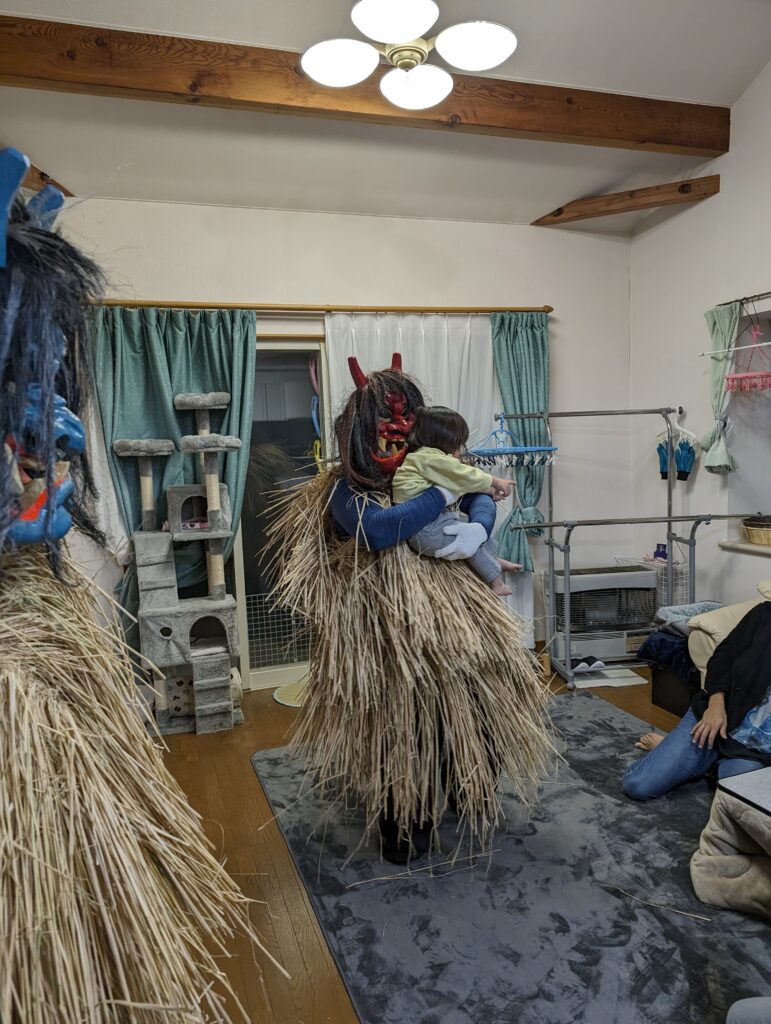
When the Namahage find the children of the household, or sometimes young women who have recently married into the family, they threaten to drag them up into the mountains, often picking them up and carrying them toward the door. The head of the household then holds the Namahage back and promises them sake, insisting that the children are in fact well-behaved. Food is then brought out on trays in the main room, and the Namahage sit down with the head of the household, who sits with the children so he can defend them against the Namahage’s accusations.
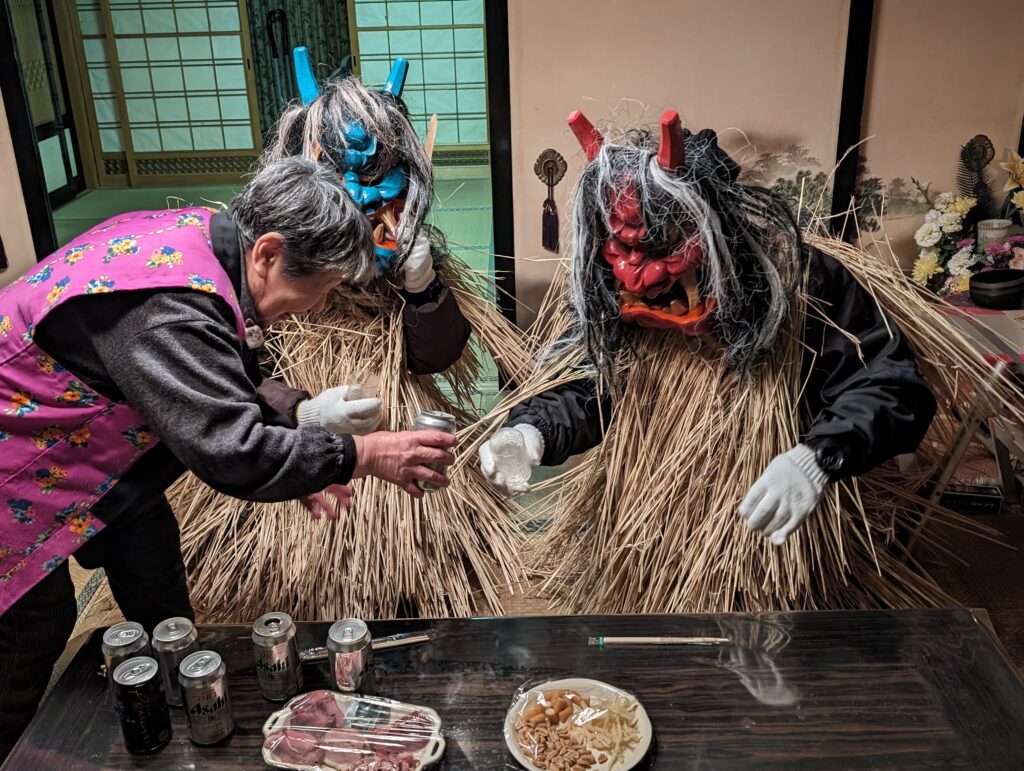
The Namahage then begin questioning the family, asking whether the children obey their parents and do their homework. The adults are questioned as well and told to cut down on drinking and smoking, treat their own parents well in their old age, and work hard. The Namahage warn the family not to lie, telling them they can see everything from the mountains. They often carry a book listing any mischief committed in the household during the year. The Namahage are also thanked for the previous year’s harvest or catch, after which they offer predictions for the year to come.
The Namahage then continue their rampaging through the house, lifting the children, slamming doors, and shouting and stomping as they move around. This is done to drive out any evil spirits that might be hiding in the home and to ensure the health and safety of the residents. When the Namahage finally leave, they are often given a gift of rice cakes or a small monetary donation.
Before they leave, they usually give one final message:
We will be back again next year!
When the Namahage have left, any straw that has fallen from their costumes is used as a protective charm. People tie it around their heads to become wiser, place it in their wallets to become wealthier, or rub it on places that hurt to make the pain disappear. The remaining straw is left on the floor until the next morning, as it is considered sacred and protects the house. In villages where fishing is the main occupation, the costumes are often made from old rope and fishing nets, which means no straw falls off.
After the Namahage finish making their way around the village, they return to the place where they began. There, they remove their costumes, and if the costumes are made of straw, the straw is tied around a tree, the torii gate of a shrine, a guardian statue, or burned in a fire. The men who wore the costumes then enjoy a well-earned meal together with their fellows.
The function of the ritual
In addition to purifying homes of negative spiritual energy and ensuring that children and adults behave properly, the ritual also serves as a rite of passage symbolizing a boy’s transition into adulthood. To become a Namahage, one must typically be around 18 years old, and one can only continue until about age 30 or until getting married (though the exact age varies by area). Once a man marries, his role shifts to that of the head of the household, and he must therefore welcome the Namahage into his home. In this way, men on Oga pass through three major stages of life through the Namahage ritual: first as children who are frightened, then as young men who become Namahage, and finally as heads of households who receive them.
Despite being terrified of the Namahage until they’re around twelve years old, the ritual is a very intimate affair. Everyone involved is from the local community, and everyone knows one another (though the children don’t know who is behind the masks). This means the Namahage can question the children and parents in a thoughtful way, since they know them well, and it also serves as a way for the adults to welcome the young men into the world of adulthood.
The ritual is also believed to strengthen the bond between parents and children. Children learn that their parents are there to protect them and want what’s best for them, and that crying doesn’t help.
It may be for this reason that most people on Oga cannot imagine New Year’s without a visit from the Namahage.
Learn more about Namahage
The Ritual
The Namahage ritual varies from village to village. Just as each place has its …

Theories
The oldest written source about the Namahage appears in the travelogue “Oga’s Cold Winds”, published by …

The Folktale
On New Year’s Eve on the Oga Peninsula, young men head to the shrines and into the mountains, where they …
The Costume
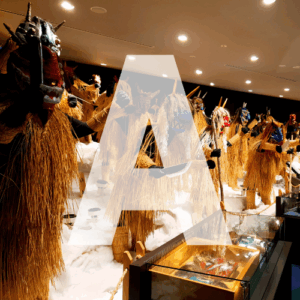
Each area of the Oga Peninsula has its own version of the Namahage. Whether it’s a neighborhood in the …

The Festival
In the old days, before the Gregorian calendar was adopted in Japan, the Namahage ritual was …

Namahage Taiko
In connection with the tourism industry, a unique form of performance has developed on Oga …

Tourism
In Akita, from the moment you step off the train at the main station or exit the plane at the airport, you are greeted by …

Gallery
Below, you’ll find a selection of videos showing the Namahage ritual as it is performed every year on …