
About Namahage
Namahage (なまはげ) is a traditional folk ritual from the Oga Peninsula in Akita Prefecture, Japan. It features men dressed as demon-like beings wearing fearsome masks and cloaks made of straw or rope. On New Year’s Eve, they visit households, shouting and startling the residents while asking whether anyone has been lazy or disobedient.
Despite their fearsome appearance, the Namahage are not evil – they act as protective spirits meant to drive away misfortune, encourage good behavior, and bring blessings for the year ahead. That’s why they’re gladly welcomed into homes, much to the terror of the children.
The Namahage tradition dates back several centuries, though no one knows exactly where it originated. Various theories exist, but there is no definitive explanation.
The word Namahage is also shrouded in mystery. Its exact origin is uncertain, though it’s believed to come from a phrase in the old Akita dialect that can be translated as “Peelers of burn blisters.”
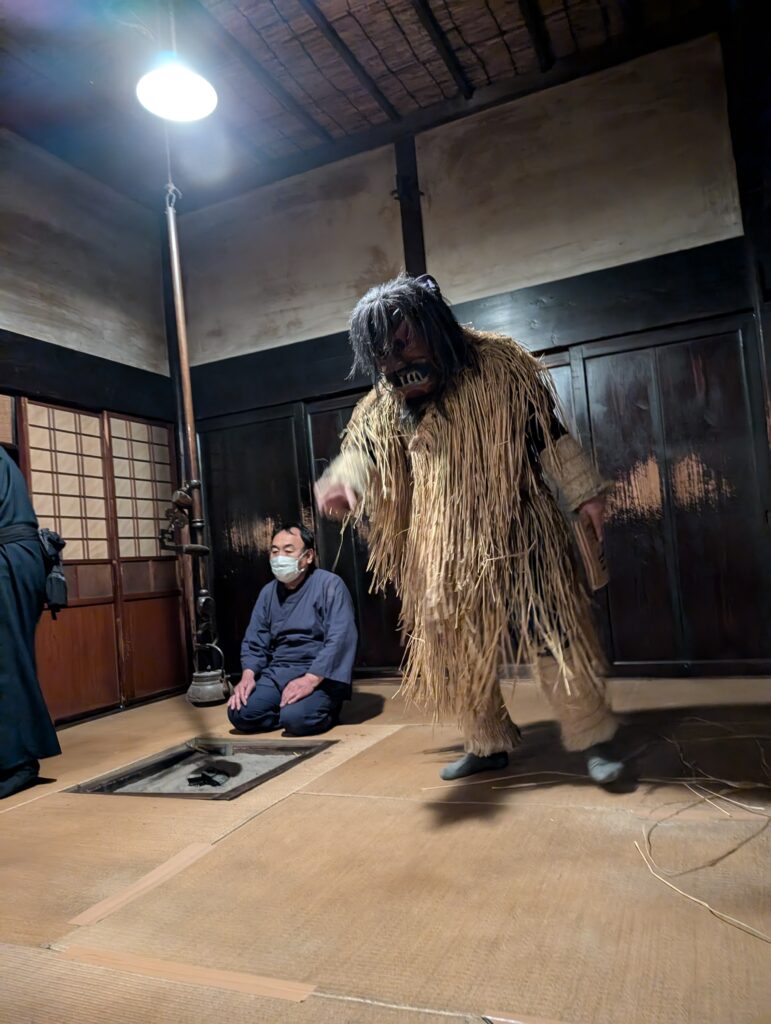

The Namahage costume, especially the masks, varies from place to place on the Oga Peninsula, with as many versions of Namahage as there are villages. Because of the ritual’s importance and its unique character, Namahage was inscribed on UNESCO’s List of Intangible Cultural Heritage in 2018.
Today, the Namahage also play a role in tourism. Visitors to the Oga Peninsula can experience performances, festivals, and a dedicated museum that offers insight into the ritual’s history and meaning. For the local community, it remains an indispensable tradition, while tourism has made it possible to share this unique cultural heritage with the rest of the world.
Learn more about Namahage
The Ritual
The Namahage ritual varies from village to village. Just as each place has its …

Theories
The oldest written source about the Namahage appears in the travelogue “Oga’s Cold Winds”, published by …

The Folktale
On New Year’s Eve on the Oga Peninsula, young men head to the shrines and into the mountains, where they …
The Costume
Each area of the Oga Peninsula has its own version of the Namahage. Whether it’s a neighborhood in the …

The Festival
In the old days, before the Gregorian calendar was adopted in Japan, the Namahage ritual was …

Namahage Taiko
In connection with the tourism industry, a unique form of performance has developed on Oga …

Tourism
In Akita, from the moment you step off the train at the main station or exit the plane at the airport, you are greeted by …

Gallery
Below, you’ll find a selection of videos showing the Namahage ritual as it is performed every year on …